
The Way of Salvation
I put my trust in Jesus Christ as my Saviour from a young age, but throughout my childhood, teenage years, and even into college, I found myself asking Jesus for salvation several times just to be sure. I have heard of many others doing the same. For me, it was not because I had a fear of hell, doubts about Jesus, or the belief that I had backslidden. Instead, I asked Jesus to save me repeatedly because I felt I needed more of Jesus in my life. Maybe you have been in a similar situation.
Well, there is a word for this – holiness. I know my pastors preached on holiness, but I was not at a point in my spiritual life where I understood what it was. I thought my salvation was the point at which I put my trust in God, and because I still had yearnings in my soul, I thought maybe the first, second, or third attempt was ineffective. The truth is that salvation is much more than a single moment in time; it is a journey with many milestones along the way.
John Wesley emphasised three primary dimensions of the salvation journey: “…pardon—salvation begun, holiness—salvation continued, and heaven—salvation finished.”1 Many Christians understand pardon – the point at which we are awakened to our need for Christ, put our faith in God, repent of our sin, and are pardoned and justified by God’s grace. We might call this “getting saved,” and it is usually the focal point of our salvation testimony that we share with others. We sing about the “wonder-working power”2 of redemption and the “amazing grace”3 received through justification.
Many Christians also understand heaven as glorification, the consummation of salvation, or entering God’s presence. We have seen the faithful saints of the church pass into eternity, acknowledging the commendation they have received from the Lord: “Well done, good and faithful servant!”4 We sing about the day “when we all get to heaven”5 and that “when the roll is called up yonder, I’ll be there.”6
It is the middle dimension, holiness as salvation continued, that we sometimes forget. Holiness is what bridges the beginning and end of the way of salvation. Wesley called this “growth in grace” and “going on from grace to grace.”7 It is growing into Christlikeness through God’s continued working in our lives throughout our salvation journey. Those yearnings I had were times when God was working in my life, wanting me to surrender more to him so that his grace and love could fill my life.
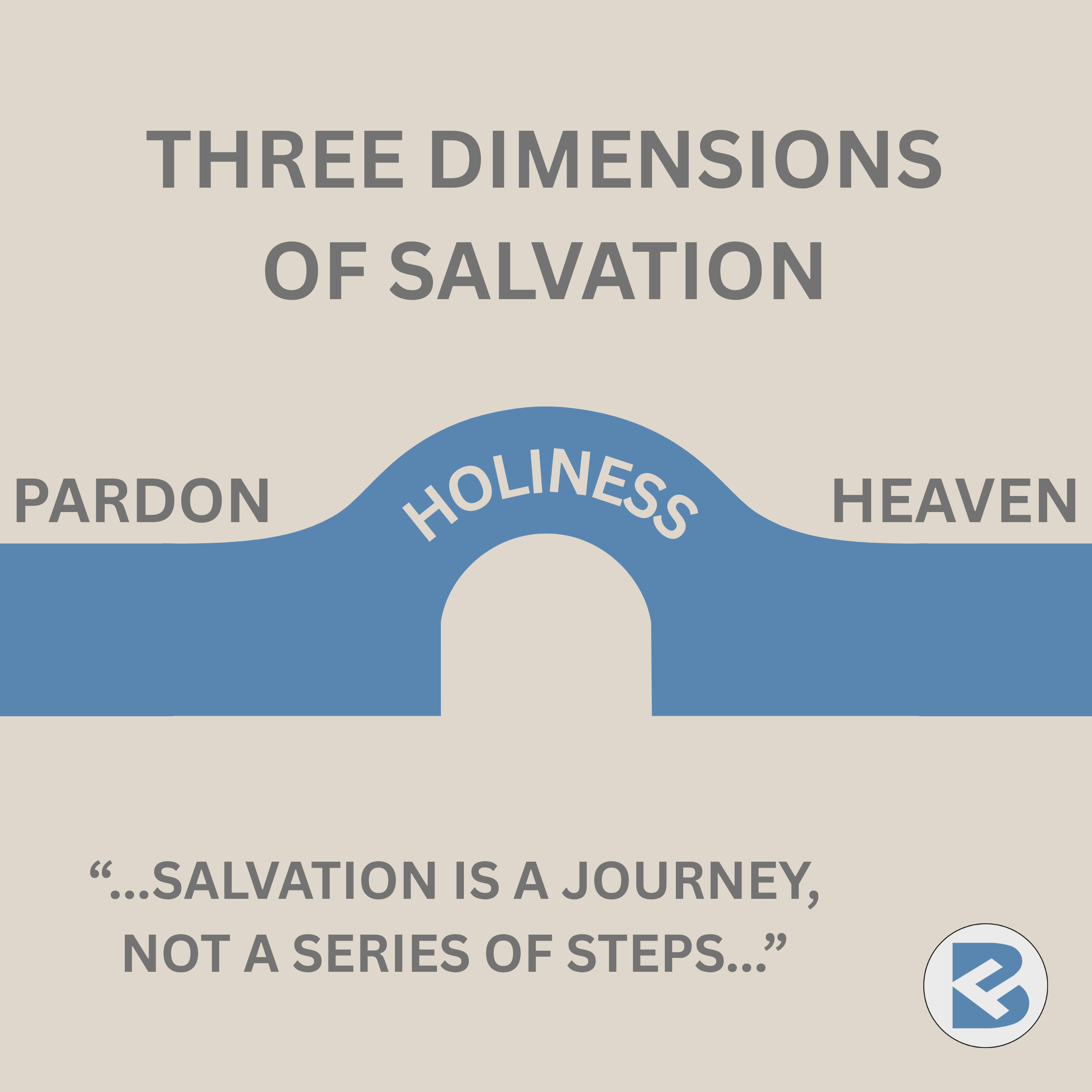
Even though holiness is the bridge on the salvation journey from pardon to heaven, this dimension of salvation also has a milestone of its own. Entire sanctification is the point at which God purifies the heart of the believer, fills the believer with his pure love, and enables them to live “self-controlled, upright, and godly lives.”8 Just as pardon is only by God’s grace at work in the believer’s life, so too is entire sanctification a work of God’s grace. John Wesley firmly believed that this was something attainable by all believers in their lifetime.9
Entire sanctification, however, is not the end of the salvation road. Believers are intended to continue growing in Christlikeness throughout their salvation. It also does not mean that a believer cannot change directions in their spiritual journey. That is why salvation is a journey, not a series of steps – for some, their journey will be straightforward with continuous momentum; for others, it may be a winding road that includes some backtracking. Each salvation journey is unique, but each begins with our pardon, crosses the bridge of holiness, and culminates in our entry into eternity for those who are faithful until the end.
Perhaps you also feel the Lord's nudging or a yearning in your heart to go deeper on your salvation journey. Those moments are good and important to spiritual maturity. In those moments, put your trust in God, fully surrendering to him anything you may be holding back, and ask him to do his purifying and refining work in your life.
1 Randy L. Maddox, Responsible Grace: John Wesley’s Practical Theology (Abingdon Press, 1994), 143.
2 Lewis E. Jones, “Power in the Blood,” Hymnary.Org, accessed September 3, 2026, [hymnary.org/text/woul...](https://hymnary.org/text/would_you_be_free_from_the_burden_jones.)
3 John Newton, “Amazing Grace!,” Hymnary.Org, accessed September 3, 2026, [hymnary.org/text/amaz...](https://hymnary.org/text/amazing_grace_how_sweet_the_sound.)
4 The New International Version (Zondervan, 2011), Matthew 25:21.
5 E. E. Hewitt, “When We All Get to Heaven,” Hymnary.Org, accessed September 3, 2026, [hymnary.org/text/sing...](https://hymnary.org/text/sing_the_wondrous_love_of_jesus_sing_his)
6 James M. Black, “When the Roll Is Called Up Yonder,” Hymnary.Org, accessed September 3, 2026, [hymnary.org/text/when...](https://hymnary.org/text/when_the_trumpet_of_the_lord_shall_black.)
7 Maddox, Responsible Grace, 177.
8 The New International Version, Titus 2:11-14.
9 Maddox, Responsible Grace, 182.